
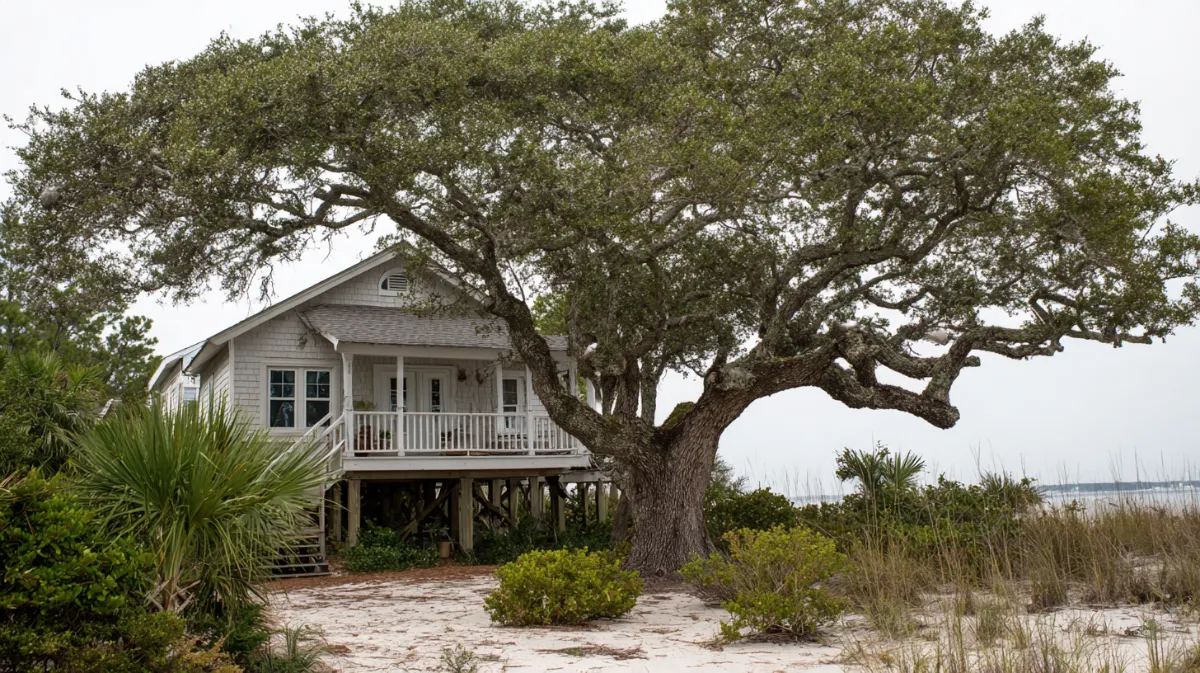
Orange Beach is mostly water: the Gulf on one side, and back bays, bayous and canals threading through neighborhoods on the other. A lot of the homes we work at sit on Perdido Bay, Wolf Bay or one of the canals, with a dock out back and a big pine or live oak between the house and the water. Those trees take wind from every direction and sit in soil that stays damp along the waterline, so roots are often shallow on the side toward the water. When a storm pushes in, those are the trees that tip, and they tend to fall toward the house, the boathouse or across the dock.
We do tree removal, tree trimming and storm cleanup across Orange Beach, from the beach side of Perdido Beach Boulevard to the bay neighborhoods to the north. Waterfront lots take extra planning, and we build it into the estimate. We've worked around docks, boat lifts, pool cages and seawalls, and we keep debris out of the water. Call for a free estimate.
Trees on Waterfront and Canal Lots
Waterfront tree work is mostly about where the pieces land. A tree between the house and the water can't just be dropped toward the canal, because a trunk in the water is a lot harder to get out than one on the lawn, and a dock, a boat lift or a seawall won't survive a falling log. So most of these trees come down in sections, with each piece lowered on ropes and carried out to the street.
Access is the other issue. Many canal lots have the house close to the road and the yard sloping toward the water, with no room for a truck. Climbers do most of the cutting, and brush gets hand-carried or winched to the chipper out front. If there's a seawall, we keep heavy equipment well back from it. For lots inland in Foley, where there's more room to work, the same tree is usually a simpler job.
After a Storm in Orange Beach
Storms reach Orange Beach from the Gulf and push water into the back bays, so after a big one you often have wind damage and standing water at the same time. A tree that fell into a canal, onto a dock or against a boathouse needs care to remove without causing more damage. We take the weight off first, cut the tree into pieces small enough to lift out, and keep debris out of the water as much as possible.
Power is usually the first problem after a storm, so stay away from any tree touching a line and wait for the utility to make it safe. Once they have, our emergency storm tree removal crews clear trees off houses, driveways and docks first, then come back for cleanup. Take photos of everything before work starts, including anything in the water, for your insurance claim.
Common Questions
Yes, though it's slower than ground work. A tree lying on a dock gets cut into pieces from the land side, lifted off with ropes or a small crane, and carried to the street so the dock isn't loaded with more weight. A tree in the water is pulled to the bank in sections and cut up there. We avoid leaving wood in the canal, since a floating log can damage boats. Photos before we start help with any insurance claim.
Removing the tree itself won't, as long as heavy equipment stays well back from the wall, which is how we work. The bigger question is the stump and roots. On some shorelines, roots help hold the soil behind a seawall or along a natural bank, so we may leave the stump in place rather than grinding it out. At the estimate we look at the shoreline and recommend the approach that fits your lot.