
The big live oaks along the Eastern Shore are part of why people move here, and they're also the trees that grow right over the roof. A limb that cleared the house by ten feet when you bought the place can be resting on the shingles a few years later, dropping leaves into the gutters and scraping in every breeze. In Daphne we trim a lot of those old oaks; in newer neighborhoods it's more often young trees that were never shaped and are now splitting at a weak fork. Down the coast, salt wind shapes trees in their own way, and a canopy can grow lopsided toward the side that gets the least spray. Good trimming fixes all of that without leaving the tree looking chopped, and it's the cheapest way to make a big tree safer before storm season.
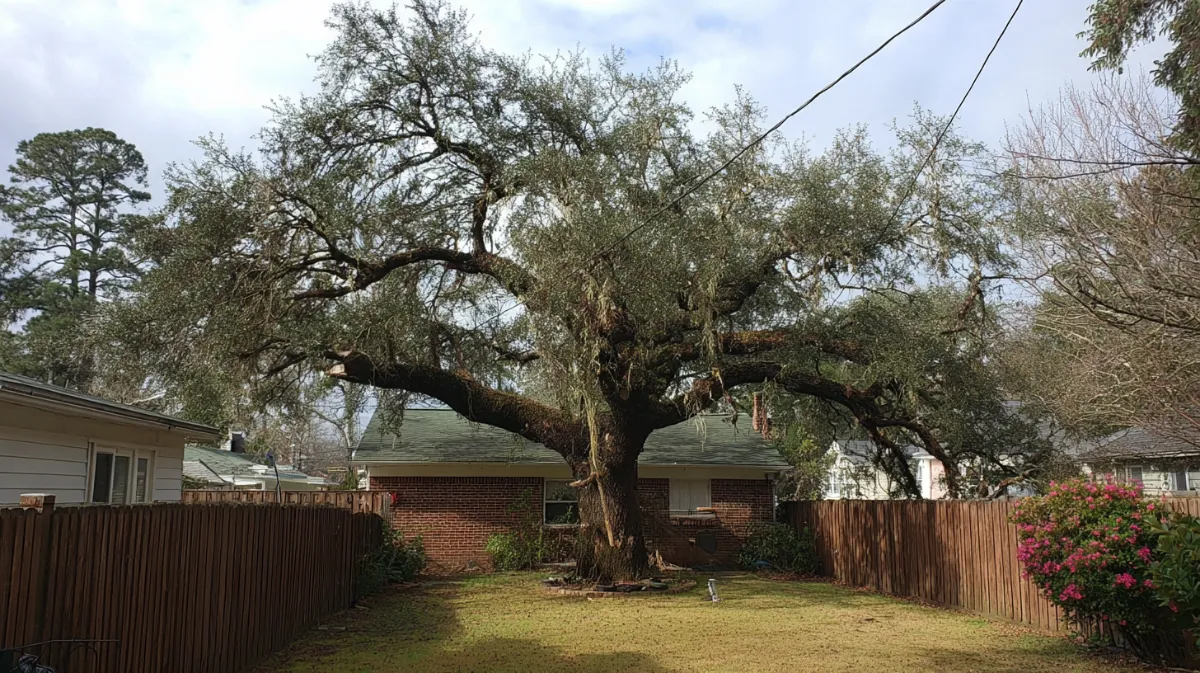
Below are the signs a tree needs work, the types of pruning and what each one does, how we do the job, and how often it actually needs doing. Most trees only need one of these done well, not all of them. If a tree is past saving, our tree removal page explains how we take it down.
Signs Your Trees Need Trimming
Limbs touching the roof, the siding or the gutters are the most common reason people call, and they're worth dealing with before a storm turns them into hammers. Branches on or near the line running from the pole to your house need attention too, though the utility handles anything on its main lines.
Dead branches are easy to spot in summer: they're the bare ones in a full green canopy, and they drop without warning. Look for crossing limbs rubbing bark off each other, a tree that's grown lopsided toward the street, or two trunks splitting apart at a tight V. Lots of Spanish moss isn't harmful by itself, but a canopy that's so thick you can't see sky through it catches a lot of wind. So does a tree that's been sending up thick shoots after a bad trim years ago; those regrowth limbs are attached weakly and tend to tear off in the first big storm.
Types of Pruning, in Plain English
Crown thinning: we take out selected branches throughout the canopy so light and wind pass through. The tree looks the same shape, just less dense. This is the main hurricane prep cut.
Crown raising: we remove the lowest limbs so you can walk, mow or park under the tree, and so the limbs clear the roof.
Crown reduction: we shorten the longest limbs back to a smaller side branch, which brings the tree's size down without leaving stubs.
Deadwooding: we remove the dead and dying branches only.
What we don't do is topping, cutting the top off a tree straight across. It looks tidy for a season, then the tree sprouts weak shoots that break easily and rot sets in at the cuts. The industry standard for this work, ANSI A300, rules topping out for good reason.
How We Trim a Tree
- We look at the whole tree from the ground first and agree with you on what comes off and why.
- A climber or a bucket truck gets into the canopy, depending on access and the tree's size.
- Each cut is made just outside the branch collar, the swollen ring where a limb meets the trunk, so the wound closes on its own. No paint or sealant needed.
- Heavy limbs over the house get lowered on ropes, not dropped.
- Brush is chipped and hauled, and the yard and roof get cleared of debris.
As a rule, we take no more than about a quarter of a healthy tree's leaves in one season. Taking more stresses it.
How Often Trees Need Trimming
Most mature shade trees do well with a trim every three to five years. Young trees benefit from light shaping every couple of years while they're growing, because fixing a weak fork early is a five-minute cut and fixing it later can mean losing half the tree.
Fast growers near the house, like laurel oaks and water oaks, may need attention more often to keep limbs off the roof. Pines need the least pruning of anything here; mostly it's removing dead lower limbs. The best time is late winter, before the spring growth push and well ahead of hurricane season. Any storm-damaged limb should come off as soon as you notice it, because a half-broken branch hanging in the canopy, what arborists call a hanger, can drop on its own weeks later.
Trimming often turns up a tree or two that really should come out; when it does, stump grinding clears the spot after removal, and we work as far south as Foley.
Frequently Asked Questions
Light trimming of live oaks is fine most of the year here. Heavy cuts are better done in late winter, when the tree is less stressed and growth is about to push out over the wounds. Summer is also when people notice the problem, a limb on the roof or a branch over the pool, and taking off one problem limb in July is better than waiting for a storm to take it off for you. We'll tell you if a job is better held for the cooler months.
A healthy mature tree can usually handle losing about a quarter of its leaves in one season. Go much past that and the tree starves itself trying to regrow, which leaves it weak and open to rot and insects. Old trees and trees already struggling should lose even less. If a tree needs more taken off than that to be safe, we'll split the work over two seasons or talk with you honestly about removal instead.
Usually, yes. Most lawn grasses here need a few hours of direct sun to stay thick, and a dense canopy shades them out. Thinning the crown and raising the low limbs lets more light reach the ground, and the difference often shows within one growing season. Under a really big live oak you may still need a shade-tolerant grass or mulched beds, but trimming almost always helps.