
Spanish Fort sits on high ground above the Mobile-Tensaw Delta, and that's what makes tree work here different from the rest of the Eastern Shore. Many homes here sit on slopes, at the edge of ravines or on lots carved out of thick woods, with tall pines and hardwoods standing just a few feet from the back deck. A tree on a slope leans downhill over time, and when the soil gets soaked in a long rain, its roots don't hold as well. Many of the trees we take out here are ones that were fine in the woods but now stand alone at the edge of a cleared lot, catching wind they never had to handle.
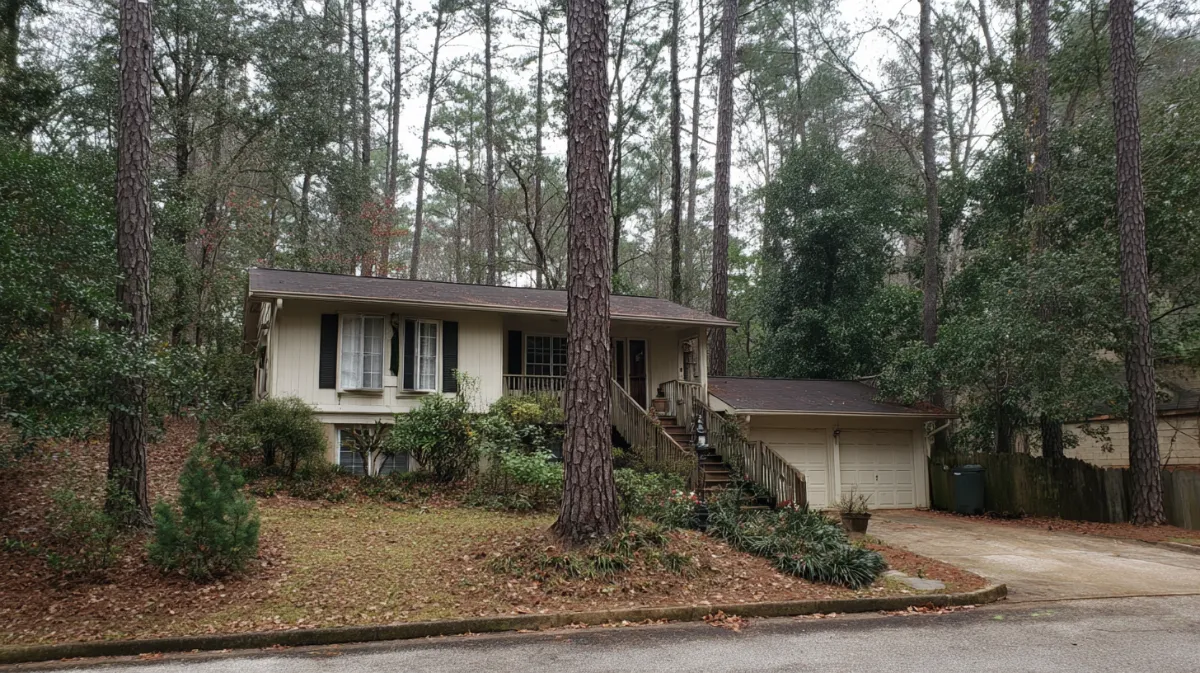
We take down pines, oaks and hazard trees across Spanish Fort, from the neighborhoods off Highway 225 to the newer streets near the Eastern Shore Centre. Our crews handle tree removal on slopes and in tight spots, plus tree trimming for limbs over the roof. Steep lots take more planning, and we build that into the estimate. Call for a free estimate.
Working on Slopes and Ravine Lots
A tree on a hillside can't be dropped the way it would be on flat ground, because a falling trunk will slide or roll once it hits a slope. On these lots we take most trees down in sections, lowering each piece on ropes, so nothing ends up at the bottom of the ravine or in a neighbor's yard. Where the tree is at the bottom of a slope and the only access is from the top, we rig the pieces back uphill.
Equipment is the other challenge. Bucket trucks need flat, firm ground, and many Spanish Fort backyards don't have it, so climbers do more of the work here than in flatter towns. Brush gets carried or winched up to the chipper on the street. It adds some time, but it keeps heavy machines off soft hillside soil that can wash out after the next storm. Homeowners on flatter lots down the shore in Fairhope see quicker, simpler jobs.
Storm Damage Above the Delta
Spanish Fort takes the wind from the bay and from the delta, and storms coming up from the Gulf hit the high ground hard. Pines here tend to snap high in the trunk, leaving a tall jagged stub and a top hung up in other trees or lying across a roof. Hung-up tops are some of the most dangerous trees to deal with, because the weight can shift without warning. We take them down from the top, never by cutting the trunk out from under them.
After a storm, call before you try to clear anything yourself, and stay out from under any tree that's leaning on another one. Our emergency storm tree removal crews take the trees off houses and driveways first, then come back for the cleanup and stump grinding. We'll document the damage as we go for your insurance claim.
Common Questions
Yes, with the right method. On a slope, a tree is never dropped whole, because the trunk would slide or roll once it lands. A climber dismantles it from above, roping every piece down, so the work stays controlled from start to finish. What's not safe is trying it yourself with a chainsaw on uneven ground. If the tree is already leaning hard downhill, keep people and pets below it out of the way until it's down.
Removing the tree doesn't pull the roots out, so the soil stays held for a while as the old roots slowly break down. On a steep Spanish Fort lot, it's still smart to get groundcover or shrubs growing on that ground within a season. We can leave the stump in place on a very steep bank instead of grinding it, since it helps hold the soil, and grind only the ones in the way.